

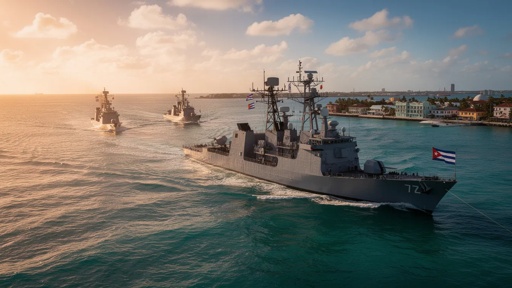
The phrase “bloodbath” was not pulled from a war movie, but from Cuba’s president warning Washington what a U.S. strike over alleged drones would mean just 90 miles off Florida’s coast.
From Drone Claims To Talk Of A Bloodbath
Reports circulating in U.S. and allied media alleged that hostile drone operations targeting American infrastructure or military assets had some link to Cuban territory or airspace. Within hours, Havana pushed back hard, denying that it hosted or facilitated such activity. President Miguel Díaz-Canel escalated the rhetoric, warning that any U.S. “military action” against Cuba would cause a “bloodbath” and shatter regional peace. That single word turned an obscure drone dispute into a front-page geopolitical scare.
American conservatives hear “bloodbath” and immediately recall how often authoritarian regimes reach for theatrical language to rally support at home. From that perspective, Díaz-Canel’s warning sounds less like calm statecraft and more like political theater aimed at a weary, economically battered Cuban public. Painting Washington as a looming invader helps shift blame for blackouts, shortages, and emigration away from Havana’s socialist system and onto the usual foreign villain.
🚨 CUBA WARNS U.S. MILITARY ACTION WOULD TRIGGER A “BLOODBATH”
Cuban President Miguel Díaz-Canel warned that any U.S. military action against Cuba would lead to a “bloodbath” with major consequences for regional stability.
The warning came after reports claimed Cuba had… pic.twitter.com/unbRIH22WD
— NewsForce (@Newsforce) May 18, 2026
Why Drones Make This Different From Old Cold War Standoffs
Drones change the script. During the Cuban Missile Crisis, Washington worried about nuclear-tipped rockets parked on the island. Today, inexpensive unmanned aircraft can conduct surveillance, probe communications, or even deliver cyber payloads without a pilot ever leaving a chair on another continent. That ambiguity—where a drone is based, who controls it, and what counts as an “attack”—makes it far easier for rival narratives to take root, and far harder to draw clear red lines that both sides respect.
American security officials, whether Republican or Democrat, cannot shrug off drone threats near home shores. Conservative common sense says a government that ignores potential hostile platforms so close to Florida is not doing its first job: protecting its citizens. At the same time, launching military strikes based on murky intelligence invites disastrous miscalculation. The challenge is to treat drone allegations seriously while demanding real evidence and exhausting defensive and diplomatic tools before anyone starts firing shots in the Caribbean again.
Cuba’s Strategy: Deterrence, Victimhood, And Domestic Control
Cuba’s leadership has long relied on a familiar mix: defiance toward Washington, appeals to international solidarity, and tight grip at home. By calling potential U.S. action a path to “bloodbath,” Díaz-Canel signals that any attack would trigger fierce resistance, heavy casualties, and potentially wider instability. That message is calibrated for multiple audiences: regional governments wary of U.S. interventionism, global left-leaning movements, and Cuban citizens who might otherwise blame their leaders for chronic hardship.
Conservative observers see a pattern. When regimes fail economically, they often reach for external threats to justify crackdowns and silence dissent. Cuba’s economic situation is dire—fuel shortages, food scarcity, and mass emigration. Warning of war and bloodshed creates justification for tougher security measures and for labeling domestic critics as accomplices of a foreign aggressor. The more Havana leans on that script, the less likely it is to pursue serious reform that might actually improve everyday life.
U.S. Calculus: Strength Without Stupidity
For Washington, the question is not whether it could win a military confrontation; the asymmetry is overwhelming. The real question is whether any strike, however limited, would be worth the costs. American conservative values emphasize peace through strength, not war for spectacle. That means securing airspace, reinforcing counter-drone defenses, and sharpening intelligence collection, while keeping powder dry unless there is unmistakable evidence of an attack that justifies a firm response under U.S. law and international norms.
Domestic politics complicate the picture. Florida’s Cuban American community and other hawkish voices will demand a tough line on any suggestion that Cuba hosts hostile platforms for U.S. rivals like Russia, China, or Iran. Yet most Americans have little appetite for another open-ended confrontation, especially one that could ignite migration surges, roil markets, and hand propaganda victories to adversaries. The smart approach balances vigilance and deterrence with caution against stumbling into war over contested drone data.
Drone disputes between the United States and Cuba will not vanish. The technology is too cheap, too widespread, and too useful for surveillance and gray-zone operations. What matters is whether both sides, and any foreign partners operating from Cuban soil, accept an unwritten rule: no crossing the line from espionage and probing into kinetic attacks. If that line blurs, a single downed drone or misinterpreted radar track could trigger escalation far beyond what either government—or the American public—actually wants.
Sources:
Cuba Warns U.S. Military Action Would Trigger ‘Bloodbath’