

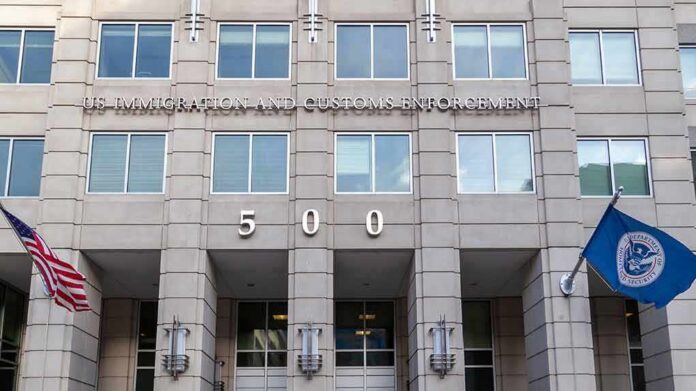
When Abdul El-Sayed says “ICE has nothing to do with immigration,” he is not denying that the agency deports people; he is arguing that its core function has drift from immigration administration toward a domestic paramilitary tool built on fear and constitutional shortcuts.
Key Points
- El-Sayed has made abolition of ICE a central, long-running plank of his political platform, describing the agency as “irredeemable” and “a paramilitary force” that must be torn down and replaced.
- In interviews and speeches, he insists “ICE is not about immigration” but about normalizing militarized federal force in everyday American communities under the pretext of immigration enforcement.
- ICE’s own mission statements, structure, and activity reports emphasize immigration enforcement, removal operations, and detention as core functions, directly contradicting any literal claim that the agency has “nothing” to do with immigration.
- The substantive dispute is less about whether ICE enforces immigration law and more about whether its design and tactics make it fundamentally incompatible with a rights-respecting immigration system, warranting abolition rather than reform.
What El-Sayed Means When He Says “ICE Is Not About Immigration”
Abdul El-Sayed has been calling for the abolition of U.S. Immigration and Customs Enforcement since at least 2018, and he has made that position a defining feature of his current Michigan Senate campaign. In multiple campaign videos and media appearances, he frames ICE as “irreformable,” “irredeemable,” and “a paramilitary force” that “has to be abolished.” The line that has drawn the most attention and outrage—“ICE has nothing to do with immigration”—appears in that context: he is using stark language to highlight what he sees as a structural transformation of the agency.
In an extended interview, El-Sayed elaborates: “ICE is not about immigration. ICE is not about the southern border. ICE is about normalizing paramilitary force on our streets… That can’t be retrained. It just has to be abolished,” while explicitly adding that he supports “a safe and secure southern border” and enforcing immigration policy, just “not like this.” In other words, he distinguishes immigration enforcement as a legitimate governmental function from ICE as the particular institutional vehicle currently carrying it out.
His campaign literature underscores the point. The campaign’s own ICE explainer states that “we must secure our border and work towards comprehensive immigration reform” but argues that Democrats should “outright reject an agency that has demonstrated that it cannot operate within the bounds of the Constitution or human decency — it must be torn down and immigration enforcement must be rethought from scratch.” In a separate long-form video conversation, he says “we need to abolish the ICE part and start fresh when it comes to immigration enforcement.” Taken together, his rhetoric uses “ICE is not about immigration” to mark ICE off from immigration enforcement as such, casting the agency as a vehicle for intimidation rather than administration.
How ICE Defines Its Own Mission and What It Actually Does
One does not need to agree with El-Sayed’s framing to see that, read literally, the claim that ICE has “nothing” to do with immigration is inaccurate. ICE’s own mission statements, statutory authorities, and public-facing descriptions repeatedly identify immigration enforcement as a core function. In a formal statement to Congress, ICE is described as “the investigative arm of the Department of Homeland Security” whose mission is to “promote homeland security and public safety through the criminal and civil enforcement of federal laws governing border control, customs, trade, and immigration.” The agency’s components—most notably Enforcement and Removal Operations (ERO)—are organized explicitly around civil immigration arrests, detention, supervision, and removals.
Activity data reinforce that point. A nonpartisan summary using ICE figures reports that between late 2014 and late 2024, ICE returned roughly 2.32 million book-ins to their country of citizenship, a direct measure of removal and deportation activity. ICE’s annual report details thousands of administrative arrests, removals, and detention operations under immigration statutes, alongside criminal investigations and customs-related work. Independent overviews—many of them critical of ICE—still describe the agency’s remit as including “detaining and deporting unauthorized immigrants” and conducting interior immigration enforcement through ERO.
In short, whether one sees ICE’s mission as legitimate or harmful, the institution is deeply tied to immigration enforcement by design and in practice. That is precisely why El-Sayed’s argument takes aim at ICE as the institutional embodiment of current enforcement; his abolitionist stance would have little force if the agency were tangential to immigration.
Paramilitarization, Constitutional Claims, and Abolitionist Rhetoric
El-Sayed’s critique turns less on the semantic question of what the agency is called and more on how it operates on the ground. He argues that under Donald Trump, immigration became “the best way for him to create a paramilitary force of thugs who he could put on your street corner to be accountable only to him,” and that ICE, under that pretext, has been “weaponized against the Constitution itself.” He points to deadly incidents involving ICE agents and describes a pattern of street-level operations, raids, and tactics that, in his view, resemble militarized domestic deployment rather than administrative processing of immigration cases.
That critique sits within a broader abolitionist discourse that has developed around policing and punishment institutions over the past decade. In abolitionist writing on police, advocates argue that some institutions are so tightly bound up with patterns of racist harm and coercive control that they cannot be meaningfully reformed; they must be abolished and replaced with structures grounded in social support and non-carceral public safety. Legal scholarship describes abolition as ending or radically transforming institutions whose mission is inseparable from harm, not simply defunding them in a narrow sense.
El-Sayed’s language tracks that tradition. He insists “ICE cannot be reformed, cannot be retrained, and has to be abolished,” and portrays the agency’s abuses as evidence that its very design is incompatible with constitutional order. He is not alone in using abolitionist rhetoric around ICE; “Abolish ICE” emerged as a slogan across parts of the American left during the Trump years. What distinguishes his position is the degree to which he has tied abolition to a specific argument about paramilitary normalization in everyday civic life.
Where the Evidence Is Strong—and Where It Is Thin
On one side of this dispute, the evidence is straightforward: ICE is structurally and operationally an immigration enforcement agency. Its statutory authorities, DHS descriptions, and public metrics point squarely to immigration-related enforcement as a central mission. Even critical summaries of ICE’s behavior and powers accept that immigration enforcement is, at minimum, a major part of what the agency does. That undercuts any literal reading of “ICE has nothing to do with immigration” as a factual statement about purpose or activity.
On the other side, El-Sayed offers a normative and structural critique rather than a forensic accounting. The record here is rich in his speeches, interviews, and campaign messaging documenting his view that ICE is unconstitutional, paramilitary, and irredeemable. Yet it does not provide internal ICE policy documents, budget breakdowns, or case-file audits showing, for example, how much of ICE’s work is interior street-level operations versus administrative processing, or how specific directives tied enforcement to partisan or electoral goals. His argument rests on a pattern he infers from high-profile abuses and the visible character of raids, not on an exhaustive institutional data set.
The institutional side is also incomplete. Mission statements and official reports tell us what ICE says it does and how it counts its actions, but they do not directly rebut his claims about paramilitarization or constitutional harm. There is no publicly available, line-by-line official refutation of his specific examples, and no neutral audit in this material that separates immigration-processing functions from what he calls “government thugs on the streets.” That evidentiary gap leaves room for competing interpretations of the same set of public events.
Why This Debate Resonates Beyond ICE
The controversy around El-Sayed’s statement is partly about immigration policy, but it is also about how Americans talk about institutions they perceive as structurally harmful. “Abolish ICE” functions much like “abolish the police”: for supporters, it signals that incremental reforms are inadequate and that the institution’s core mission or methods must be replaced; for opponents, it reads as a reckless call to eliminate enforcement altogether. In that environment, one absolutist line—“ICE has nothing to do with immigration”—can be clipped and repeated without context, flattening his broader argument about mission drift into a sound bite that is easy to mock.
El-Sayed’s critics highlight the agency’s name, its statutory role, and its deportation statistics to argue that his position reflects either ignorance or ideological extremism: how can an agency called Immigration and Customs Enforcement have “nothing” to do with immigration? His supporters, by contrast, emphasize the way ICE shows up in neighborhoods, workplaces, and public spaces, and the degree to which its visible presence feels more like militarized policing than administrative casework. Both sides are reacting not just to what ICE is on paper, but to what it represents in the current political imagination.
For voters trying to make sense of the debate, the key is to separate the descriptive claim from the abolitionist thesis. Descriptively, ICE is an immigration enforcement agency. Whether it has been used or designed in ways that justify abolishing and replacing it is a much harder question—one that cannot be settled by mission statements alone, but also cannot be fairly argued without them.
What Abolition of ICE Would—and Would Not—Mean
Finally, it is worth clarifying what El-Sayed himself says would follow from abolishing ICE. He does not advocate open borders or an end to immigration law; he pairs his abolition call with support for “a safe and secure southern border” and “comprehensive immigration reform,” including a pathway to citizenship and due-process-centered enforcement. In his own words, the goal is to “start fresh when it comes to immigration enforcement,” building a new institution—or set of institutions—whose mission and methods align with constitutional protections and human rights.
Whether that program is desirable or feasible is a political judgment. But understanding his claim accurately requires placing that stark phrase—“ICE has nothing to do with immigration”—inside his broader argument: that the current agency has become, in his view, an instrument of domestic paramilitary control under the cover of immigration enforcement, and that immigration policy itself must be disentangled from that apparatus if it is to be legitimate.
Sources:
twitchy.com, youtube.com, breitbart.com, thepostmillennial.com, forumtogether.org, en.wikipedia.org, ice.gov, usafacts.org, dhs.gov, charlesinternationallaw.com, legalwin.org, medium.com, educationusa.state.gov, cambridge.org, ebsco.com, abolitionistlawcenter.org