

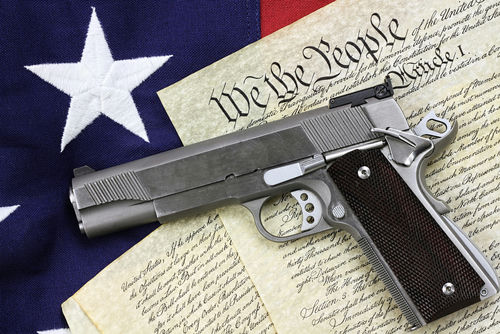
Maryland just banned the most widely owned handgun in America, and the ink was barely dry before three major gun-rights organizations filed federal lawsuits to stop it.
Story Snapshot
- Governor Wes Moore signed Senate Bill 334 into law, prohibiting the sale, purchase, or transfer of Glock and Glock-style pistols in Maryland beginning January 1, 2027.
- The law targets what it calls “machine gun convertible pistols,” defined by a specific internal trigger design found in most Glock models.
- The National Rifle Association (NRA), Firearms Policy Coalition, and Second Amendment Foundation each filed separate federal lawsuits on the same day Moore signed the bill.
- Active and retired law enforcement are exempt from the ban, a carve-out critics say exposes the law’s uneven logic.
What Maryland’s SB 334 Actually Does
Senate Bill 334 does not name Glock by brand in its text. The law defines a prohibited firearm as a “machine gun convertible pistol,” which it identifies by the presence of a cruciform trigger bar, a mechanical feature found in most Glock pistols and many similar designs. Maryland State Police will publish the official prohibited-model list before the January 2027 effective date. The practical result is a ban on the most popular handgun platform sold in the United States today.
Supporters, including gun-safety advocacy group Everytown for Gun Safety, celebrated Maryland becoming the second state in the nation to restrict the sale of what they call DIY machine guns. The concern driving the law is the widespread availability of illegal conversion devices, commonly called Glock switches or auto sears, which can be inserted into compatible pistols to enable fully automatic fire. Those devices are already illegal under federal law. The bill’s backers, including representatives from the Annapolis, Montgomery County, and Baltimore City police departments, argued that restricting the base firearm is the more effective enforcement strategy.
Three Lawsuits Filed Before the Ink Dried
The NRA, the Firearms Policy Coalition, and the Second Amendment Foundation each filed federal challenges to SB 334 on May 27, 2026, the same day Governor Moore signed the bill. All three organizations argue the law violates the Second Amendment’s protection of firearms in common use for lawful self-defense, the standard established by the Supreme Court in District of Columbia v. Heller. No court has yet ruled on the merits, but the speed and coordination of the legal response signals this fight is heading to the federal bench fast.
The constitutional argument here is not frivolous. Glock-style pistols are not niche firearms. They are the dominant platform used by American law enforcement and private citizens alike. A law that effectively removes the most commonly owned handgun from the civilian market faces a serious Heller problem, and courts will have to wrestle with whether the “convertible” framing is a genuine public-safety distinction or a workaround designed to ban a common arm by technical definition rather than by name.
The Law Enforcement Exemption Deserves a Hard Look
Active and retired law enforcement officers are exempt from SB 334. That exemption is worth pausing on. If a Glock-style pistol is so dangerous that ordinary Maryland residents cannot purchase one after January 2027, the danger presumably does not disappear when the buyer carries a badge. The exemption is a standard feature of gun-control legislation, but it consistently undermines the public-safety rationale by creating a privileged class of gun owners whose safety apparently requires the very firearm everyone else is forbidden to buy.
BREAKING: Maryland Democrat Governor Wes Moore just signed a "Glock Ban" into law.
The most popular handgun in America — used by law enforcement and millions of responsible gun owners — is now banned from sale, manufacture, and transfer in the state starting Jan 1, 2027. pic.twitter.com/2SXyA8ENle
— Trump Nesara gesara (@Trumpnesara1g) May 28, 2026
Maryland Republicans called on Moore to veto the bill before he signed it, and the opposition’s core argument is straightforward: the conversion devices causing the problem are already illegal, so the logical enforcement target is the switch, not the pistol. That argument has real merit. No evidence in the public legislative record establishes that banning the base firearm reduces switch trafficking more effectively than prosecuting the devices themselves. The state has not released Maryland-specific incident data, trace evidence, or an outcomes study connecting Glock-style pistols to a distinct local crime pattern. Legislating without that evidentiary foundation is exactly the kind of policy overreach that ends up in front of a federal judge, which is precisely where this law now sits.
Sources:
[1] Web – Maryland’s Democrat Governor Just Signed a Law Banning the Most …
[2] Web – Glock pistol ban: MD House GOP calls on Wes Moore to veto bill
[3] YouTube – BREAKING: Maryland Governor Signs Glock Ban Bill
[4] Web – SUN: Bill targeting Glock-style pistols heads to Gov. Wes Moore’s desk
[5] Web – NRA Files Lawsuit Challenging Maryland’s Glock Ban
[6] Web – VICTORY FOR GUN SAFETY: Maryland Becomes Second State in …
[7] Web – Gov. Moore signs Youth Charging Reform Act, ICE face mask ban …
[8] Web – FPC Files Federal Lawsuit Challenging Maryland “Glock Ban”
[9] Web – SAF FILES LAWSUIT CHALLENGING NEWLY SIGNED MARYLAND …
[10] Web – NRA sues MD officials over Glock pistol ban – The Daily Record
[11] Web – Maryland Moves to Ban Glock Style Pistols – Guns.com