
A Pentagon briefing room clash reveals more about press behavior than military policy when Secretary of War Pete Hegseth publicly dressed down a reporter who interrupted him during a high-stakes discussion on Iran.
The Interruption That Stopped a Briefing Cold
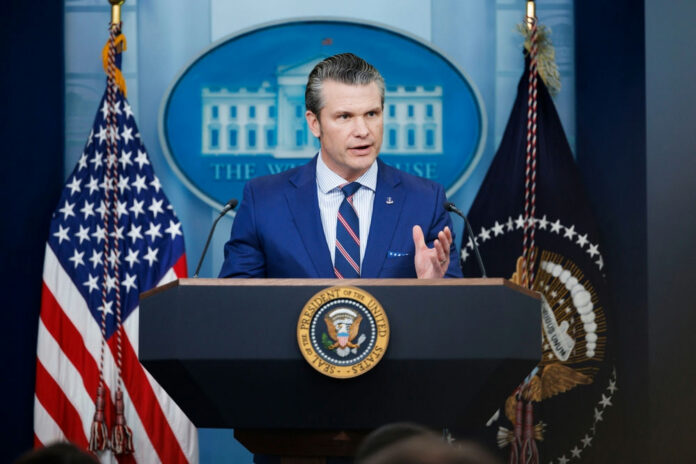
Secretary of War Pete Hegseth commanded the Pentagon podium on April 8, delivering updates on a fragile ceasefire with Iran when a reporter interjected out of turn. Hegseth didn’t miss a beat: “Excuse me, why are you so rude? Just wait. I’m calling on people.” He muttered “So nasty” under his breath before continuing with his planned sequence of questions. The moment crystallized a broader tension between military leadership attempting to control sensitive information flow and media professionals pushing for immediate answers during crisis moments.
The briefing centered on Operation Epic Fury, a military posture involving pre-positioned strike capabilities against Iranian bridges and power plants designated as dual-use infrastructure supporting terror operations. Hegseth’s firm handling of the interruption reflected the gravity of the subject matter: a ceasefire teetering on compliance monitoring, nuclear non-negotiability, and President Trump’s public threat via Truth Social to “wipe out a civilization” if Iran missed the deadline. The stakes demanded order, and Hegseth enforced it without apology.
When Press Access Collides With Protocol
The unnamed reporter’s attempt to bypass the established question queue violated basic briefing room etiquette, a fact not lost on observers who noted the exchange. Hegseth’s authority in the room was absolute, yet the media’s role as challenger persisted despite his rebuke. This dynamic plays out repeatedly in administrations that view press skepticism as obstruction rather than accountability. The reporter yielded immediately after the scolding, suggesting even adversarial journalists recognize boundaries when military commanders draw them clearly and publicly.
Conservative coverage uniformly portrayed the incident as Hegseth “firing back” appropriately against rudeness. Fox News emphasized the exchange as evidence of principled leadership willing to confront media entitlement. No counter-narrative emerged questioning Hegseth’s tone or approach, reflecting either genuine consensus on the reporter’s breach or the dominant ideological framing of available sources. The absence of the reporter’s identity or organizational affiliation in coverage prevents assessing potential bias motivations, leaving only the behavior itself as the judged offense.
Operation Epic Fury and the Iran Powder Keg
Hegseth’s briefing detailed a ceasefire holding by threads, with U.S. military forces monitoring the Strait of Hormuz for compliance while commerce cautiously resumed. He described Iran’s nuclear ambitions as non-negotiable, stating Tehran must surrender capabilities “voluntarily or if we have to do something else ourselves.” The phrasing left little doubt about American resolve, backed by what military officials described as “locked and loaded” targets across Iranian territory. General Cain’s role in monitoring operations underscored the operational readiness behind Hegseth’s diplomatic language.
NEW: Secretary of War Hegseth shuts down reporter's provocative question:
REPORTER: "When you give these orders to carry out this extreme level of violence, what's going through your mind and your body? Do you have, like, an adrenaline rush? Are you scared? Do you feel like… pic.twitter.com/JdQmyKXfuF
— Fox News (@FoxNews) April 24, 2026
President Trump’s public ultimatum added pressure to an already volatile situation. His Truth Social threat to obliterate Iran if nuclear deadlines passed demonstrated the administration’s preference for maximum pressure diplomacy backed by credible force. Markets reacted positively to the Strait’s reopening, indicating economic confidence in U.S. deterrence capabilities. Yet the long-term implications remain uncertain: either the ceasefire stabilizes into verifiable denuclearization, or the pre-positioned strikes Hegseth described become operational realities. The interrupting reporter likely sought clarity on this exact calculation, timing the question poorly but pursuing a legitimate line of inquiry.
The Broader Message on Media Relations
Hegseth’s background as a Fox News personality before his appointment suggested comfort with combative media exchanges, and the April 8 incident confirmed that pattern. His willingness to publicly chastise a reporter signals an administration uninterested in traditional deference to press access norms. This approach resonates with Americans weary of gotcha journalism during national security crises, even as it raises questions about transparency when military actions carry civilization-ending stakes. The reporter’s rudeness provided Hegseth a clean justification for asserting control, but the underlying tension between information access and operational security persists regardless of decorum.
The Pentagon briefing room has witnessed decades of contentious exchanges, yet Hegseth’s directness stands out for its lack of diplomatic cushioning. Calling out a reporter as “rude” and “nasty” in real time breaks unwritten codes of mutual professional respect, replacing them with a transactional accountability: follow the rules or get corrected publicly. Whether this approach strengthens or weakens the administration’s credibility depends on execution consistency and the accuracy of the information ultimately provided. One interrupted question answered poorly damages trust more than a dozen orderly exchanges conducted with precision.
Sources:
Hegseth snaps at ‘rude’ reporter interrupting Pentagon briefing on Iran – Fox News
Hegseth snaps at reporter – Fox News Video