
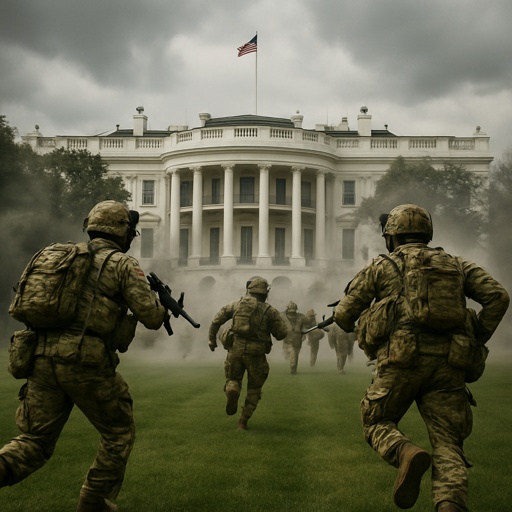
Gunfire reports near the White House triggered a lockdown, and the first public accounts left Americans with more questions than answers.
White House Security Went Into Immediate Response Mode
Secret Service personnel moved fast after reports of shots near the White House complex, and the area was placed under lockdown while agents and police responded. A report from the scene said reporters on the North Lawn were rushed inside, which shows how quickly a security event can disrupt the nation’s most protected residence. The reaction itself is significant because it reflects the seriousness with which federal protection teams treat any possible weapons incident near the executive mansion [1].
The official line remained careful rather than declarative. The United States Secret Service said it was investigating a shooting incident near the main magnetometer screening area and added that the president, first lady, and all protectees were safe [2]. That wording matters. It confirms an active law-enforcement response, but it does not by itself identify the sounds as gunfire through forensic proof. For readers concerned about government transparency, that distinction is important.
What the Broadcast Reporting Shows
On-air coverage described apparent gunshots near the White House in real time, and that is why the moment spread so quickly through television and social media. Reporters at the scene said they heard the sounds and were told to take cover, which made the incident feel immediate and alarming to viewers watching live [1]. The best-supported conclusion from the available record is that trained journalists and security personnel treated the situation as credible enough to trigger an urgent response.
At the same time, the record provided here stops short of proving exactly what caused the noise. No raw broadcast clip, audio analysis, shell-casing report, or ballistic finding is included in the research package [2]. That limitation matters because live events near the White House can produce confusion, and early descriptions can outrun hard evidence. Conservatives who value order and facts should be wary of turning an investigation into a final conclusion before the facts are fully released.
Why the Distinction Between Reported and Confirmed Matters
This episode underscores a broader problem in modern breaking news: the public often gets the first version before the verified version. When federal officials release only a narrow statement and newsrooms rely on live impressions from the scene, the story can harden around words like “gunshots” before anyone has confirmed the source. That gap leaves room for misinformation, overreaction, and unnecessary panic, especially when the location is the White House and the stakes involve presidential security [2].
🚨 BREAKING: Multiple gunshots fired near the White House North Lawn
Reporters on scene report hearing around 30 shots. Secret Service immediately rushed press into the briefing room, locked down the complex, and deployed countersnipers on the roof.
In this video, ABC News…
— Natural Sense I Am (@NaturalSenseIAm) May 24, 2026
There is also a practical lesson for Americans tired of chaos and sloppy institutions. A serious security event near the White House should produce fast protection and fast clarity, not a fog of partial statements and internet rumor. The response appears to have protected the people who mattered most, which is what citizens expect from the federal government [2]. But the lack of publicly available forensic detail means the full account is still incomplete, and that is something the public should not ignore.
Sources:
[1] Web – 2026 White House Correspondents’ Dinner shooting – Wikipedia
[2] Web – Reporters told to run as gunshots heard near White House – 1News