
A Michigan home-care nurse caught on video talking about driving to Washington with a “neck knife” has gone from viral outrage to a federal investigation, becoming the latest flashpoint in America’s uneasy collision between free speech, political violence, and a failing governing class.
Story Snapshot
- A Michigan nurse’s graphic rant about Trump, including a “neck knife” reference, has triggered a Secret Service probe and nationwide backlash.[1]
- Federal law allows the Secret Service to investigate social-media remarks that can reasonably be read as threats against former presidents.[4]
- Missing video transcripts and official filings mean the public still cannot independently verify exactly what she said or how serious it was.[1]
- The case highlights how ordinary workers, online mobs, and powerful federal agencies collide in an America where many believe the system no longer plays fair.
What The Nurse Allegedly Said And Why It Exploded Online
According to international news coverage, the controversy centers on a short video of a Michigan registered nurse, identified online as Rhonda Lee, making profane and violent remarks about an unnamed man believed by many viewers to be former President Donald Trump.[1] Reports say she talks about going to Washington, District of Columbia, taking a knife to his throat, asking God to “kill this” man, and saying he “needs to die,” while ending with a line about driving up there with her “neck knife.”[1] However, these outlets also note that Trump is not mentioned by name in the recorded clip, leaving a gap between what viewers infer and what is actually spoken on tape.[1]
News accounts describe how conservative commentators and political accounts on the platform X rapidly circulated the video, identifying Lee as a home-care nurse who works with elderly patients.[1] That online exposure turned what may have started as a heated, foul-mouthed rant into a national story framed as a health-care worker calling for the assassination of a former president.[1] Within hours, calls for her firing and prosecution began trending as users demanded action from her employer and federal law enforcement, illustrating how social-media outrage can become an informal, but powerful, enforcement mechanism in a polarized environment where both left and right feel institutions no longer protect ordinary people fairly.[1]
Secret Service Authority And The Line Between Rant And Threat
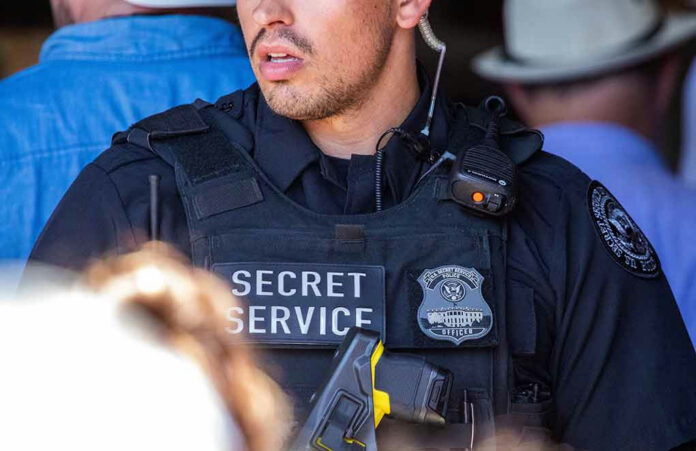
Under United States law, the Secret Service has clear authority to investigate threats against former presidents and other protectees, including statements made online.[4] The Justice Department’s Criminal Resource Manual explains that prosecutors can pursue cases where a statement could reasonably be perceived as a threat and where context suggests the speaker intended it as such, even if they do not openly spell out a plan or timeline.[4] Past cases show that agents routinely open investigations over social-media posts that reference killing or harming a president or candidate, and interviews with those speakers are treated as standard operating procedure, not an extraordinary step.[1][4]
That backdrop matters now because security around Trump has already been tightened after credible overseas threats and a recent attempt on his life, making the Secret Service even less likely to shrug off any apparent call for violence.[3] When a clip of a nurse talking about using a knife on a man many assume is Trump goes viral, Washington decision-makers and career agents know they will be blamed—by both sides—if they guess wrong and something happens later.[3] So even if Lee’s comments were drunken venting, dark humor, or political hyperbole, the system is built to err on the side of investigation, not charity, whenever the target is a former president.[1][3][4]
Missing Evidence, Media Spin, And A System People No Longer Trust
Despite the intense reaction, crucial pieces of evidence remain out of public view. The full, original video has not been released through official channels, and there is no neutral, verbatim transcript in the record, which means outsiders cannot confirm the exact words, tone, or whether anything was edited.[1] No publicly available affidavit, indictment, or Secret Service statement lays out the specific language they consider threatening or explains how they weighed her intent, mental state, or broader posting history.[4] All the public currently sees is that agents are “investigating,” which signals seriousness but does not tell citizens whether this is a box-checking interview or the start of a prosecution.
That information vacuum creates fertile ground for every existing fear about the “deep state” and a politicized justice system. Conservatives who lived through years of open calls to “punch a Nazi” and public fantasies about harming Trump now see a working-class nurse pursued by powerful federal agents and ask why threats from celebrities or activist professors rarely seem to draw the same heat.[1] Liberals, watching political violence rise and convinced “America First” has unleashed dangerous extremism, see a system still too slow to clamp down on genuine threats.[3][4] Both sides, for different reasons, are left with the sense that officials, corporations, and media outlets enforce rules selectively to protect their own interests, not to uphold equal justice.
Why This Case Resonates Far Beyond One Nurse In Michigan
Nurses’ groups and policy researchers have been warning for years that the United States nursing workforce is under intense pressure from the aftershocks of the pandemic, unsafe staffing levels, and moral injury, with many on the brink of leaving the profession. When a nurse under that strain ends up at the center of a political firestorm, it drives home how little margin for error ordinary workers now have in a country where a few seconds of video can cost you your livelihood and invite federal scrutiny. At the same time, the law does not—and arguably cannot—give a free pass when people publicly flirt with political violence against national leaders, especially in an era of copycat attacks and online radicalization.[1][3][4]
This tension—between the real need to prevent violence and the real danger of turning every ugly outburst into a federal case—is exactly what feeds the growing belief that the American system is failing. Citizens see agencies expanding their power into the digital town square; they see media outlets rewarding the most sensational framing; they see employers and bureaucrats protecting themselves first, and workers last.[1] Whether Rhonda Lee is ultimately charged or quietly cleared, the deeper problem remains: a political and legal culture that waits to act until anger boils over, then responds with blunt force instead of honest, transparent accountability that treats ordinary Americans as citizens, not pawns.
🚨 Secret Service is investigating a Michigan nurse who went on a disturbing rant threatening to slit President Trump’s throat, saying she wanted to “give him a smiley face across his goddamn neck.”
Words have consequences, especially when you’re openly fantasizing about…
— Mario Nawfal (@MarioNawfal) June 2, 2026
Sources:
[1] Web – Michigan nurse filmed threatening to slit Trump’s throat now under …
[3] YouTube – Secret Service investigate threat toward Trump by woman with Fort …
[4] YouTube – Secret Service director asked if Trump rally perimeter was too small …