
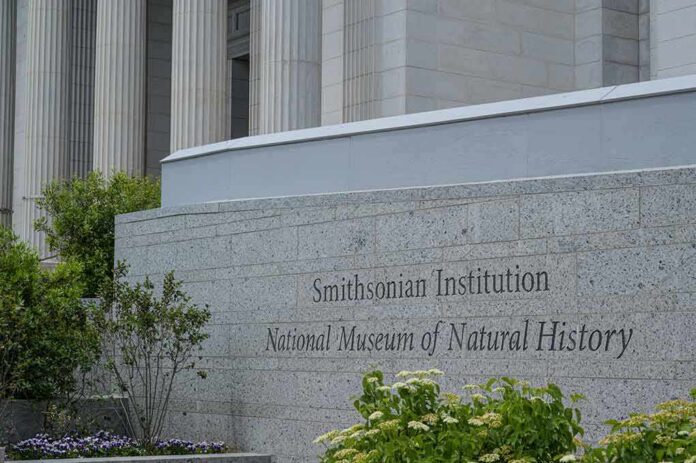
When politicians try to commandeer museums, they are not merely quibbling over labels; they are contesting the public’s shared memory, which is why battles over the Smithsonian have become a proxy fight over who gets to define American history and, by extension, democratic identity.
At a Glance
- Rep. Ayanna Pressley frames Trump-aligned efforts to reshape Smithsonian content as an authoritarian bid to control history, particularly Black history.
- A March 2025 executive order and subsequent White House reviews sought to align Smithsonian exhibitions with a program of “celebrating American exceptionalism” and removing “divisive” narratives.
- Museum sector groups and historians warn these directives risk a chilling effect on scholarship and curatorial independence across U.S. cultural institutions.
- Because the Smithsonian is federally funded and symbolically central, interventions there ripple across the entire museum ecosystem.
What Pressley Is Arguing, and Why It Resonates
Representative Ayanna Pressley has placed the Smithsonian dispute in a familiar historical pattern: autocratic movements seek to control the past to control the polity. On the House floor and in committee hearings, she charged that Trump’s executive actions and allied oversight maneuvers aimed to turn national museums into “instruments of MAGA propaganda,” erasing or sanitizing narratives—especially Black history—that complicate an uncomplicated triumphal story of the nation. Her line of argument is not rhetorical flourish; it locates museum content policy within the architecture of power, treating curatorial independence as a democratic guardrail rather than a professional nicety.
The substance behind that framing is straightforward. The White House initiated a formal review of Smithsonian exhibitions and educational materials, instructing alignment with directives to celebrate American exceptionalism and eliminate “divisive or partisan narratives.” The guidance was tethered to appropriations control, a powerful lever in a federally supported institution. In practice, such criteria are elastic—what counts as “divisive” often maps onto contemporary political fault lines—so the standard itself can become an instrument of viewpoint regulation rather than a neutral quality bar.
How Federal Leverage Meets Museum Governance
To understand the stakes, recall how the Smithsonian sits at the intersection of scholarship, public trust, and federal oversight. It is not a cabinet agency; it is a unique trust instrumentality with a Board of Regents, a public service mission, and a large operating budget drawn in part from congressional appropriations. That structure has always invited political attention, but curatorial judgment—what to collect, how to interpret, how to contextualize—has traditionally been buffered by professional norms and peer review. When an administration conditions resources or reputational standing on adherence to an ideological test, the boundary between oversight and interference blurs, sometimes decisively.
Sector bodies and historians flagged precisely that risk. The American Alliance of Museums and allied organizations warned that the administration’s intervention could chill scholarship across the field; if the Smithsonian trims or reframes narratives to satisfy political criteria, regional museums and affiliates may follow suit out of caution or to protect funding and relationships. Journalistic and academic reporting documented a formal White House process—a directive, letters of instruction, and a critical report targeting exhibits as “extreme political activism”—which, taken together, signaled an intent to re-center national interpretation on a narrower story of unity and pride.
The Evidence Trail: Orders, Reviews, and “Divisive” Narratives
The chronology is clear enough for non-specialists to follow. In 2025, the administration issued directions linking Smithsonian content to preferred themes and initiating content reviews. Newsrooms obtained and summarized those documents, including the White House’s “Saving America’s Story” framing and letters to Smithsonian leadership; histories and free-speech scholars parsed the constitutional and institutional implications. Even sympathetic commentators who favor more celebratory narratives concede the mechanism: executive direction plus funding leverage equals curatorial pressure. Whether one applauds or deplores the goal, the tactic is not imaginary; it is on paper.
Pressley’s congressional interventions—floor remarks, letters with colleagues calling for an Inspector General review, and pointed questioning during oversight hearings—sit squarely on that record. She characterized the policy as an effort to erase or dilute Black history, linking it to a trans-ideological pattern where regimes hostile to pluralism target culture, education, and archives first because they shape what the next generation can know and say. That is a claim about strategy, not just taste, and it coheres with how cultural politics has operated elsewhere and earlier.
Authoritarian Playbooks and Cultural Institutions
Historians who study authoritarianism have long noted the sequence: redefine acceptable narratives; stigmatize dissenting scholarship as unpatriotic; centralize gatekeeping; reward compliant institutions; penalize recalcitrant ones. In testimony and public interviews, scholars invoked the 20th-century record—most starkly, the Nazi state’s campaign against “degenerate” art—not to equate present actors with past tyrants, but to describe the function of cultural control in illiberal projects: constrain the imaginative commons, and you constrict the democratic one. Museums, libraries, and school systems are durable targets precisely because they sit upstream of civic understanding.
This is why language like “divisive” becomes operationally significant. In scholarly practice, grappling with conflict—over slavery, race, gender, labor, immigration—is not divisive; it is the subject matter of history. Rebranding conflict as a pathology to be excised rather than a reality to be studied gives political actors discretion to purge context and complexity. When that rebranding is married to funding levers, curators must either self-censor or risk sanction. Sector leaders labeled the anticipated result a chilling effect: exhibits shift from inquiry to affirmation, audiences get a flattened past, and the institution’s credibility erodes.
Where the Disagreement Actually Lies
The live disagreement is not whether the White House sought to steer Smithsonian content—it did—but whether such steering constitutes rightful democratic correction or improper political interference. Proponents of intervention argue that publicly funded museums should reflect civic unity and pride, and they accuse elite curators of imposing ideologically tendentious frameworks that alienate large swaths of the public. They therefore view directive oversight as restoring balance. Critics counter that replacing scholarly standards with political litmus tests subordinates evidence to sentiment and exposes the core mission—truth-seeking through documented inquiry—to the volatility of electoral cycles.
An expert assessment weighs mechanism against mission. Mechanism first: guidance tethered to appropriations and framed around viewpoint categories is an inherently blunt instrument; it incentivizes compliance to a theme, not excellence in method. Mission next: museums exist to convene evidence, argument, and interpretation in public. When the range of admissible interpretations is pre-screened for harmony, the institution no longer teaches citizens how to think with complexity; it teaches them what to think. That is not curation; it is catechism.
Why the Smithsonian Fight Matters Beyond Washington
Because the Smithsonian is the symbolic apex of America’s museum system—high visibility, high foot traffic, high trust—its curatorial moves are emulated nationwide. Affiliates calibrate their own risk, boards watch federal cues, and donors infer what content carries reputational safety. The result is policy contagion: a directive intended for a handful of galleries can alter what children encounter in a county museum 1,000 miles away. That diffusion effect is precisely what alarms the professional associations and prompts members of Congress to press for Inspector General scrutiny and guardrails.
The practical consequences are measurable. Staff spend more time translating political edicts into exhibit checklists than improving scholarship; wall texts get laundered of friction; funding cycles harden around theme compliance; recruiting diverse curatorial voices becomes harder if candidates infer that honesty endangers careers. Perhaps most importantly, public trust—painfully built over decades after earlier politicizations—suffers. Museums can recover from a bad exhibition; they struggle to recover from the perception that the past is curated to please power.
What Safeguards Work
Guarding against political overreach does not mean curators operate without accountability. It means accountability is routed through professional standards: transparent sourcing, peer review, advisory panels that include multiple schools of interpretation, and open archives that let citizens inspect the evidence themselves. Congressional oversight can strengthen this infrastructure—fund independent review boards, require public rationales for major reinterpretations, and protect whistleblowers—without imposing ideological tests. The constitutional horizon matters too: while the Smithsonian’s unique status complicates First Amendment analysis, viewpoint discrimination by government actors leveraging public funds to dictate content triggers the very concerns that free-speech jurisprudence was built to restrain.
Pressley’s case, rooted in this architecture rather than in a single exhibit or label, lands on a clear civic judgment: in a pluralistic republic, museums must be capacious enough to hold uncomfortable truths, and government must be restrained enough to let them. The alternative is a past engineered to be soothing. That is not history. It is propaganda.
Sources:
youtube.com, pressley.house.gov, mediaite.com, hyperallergic.com, museumsassociation.org, everylibrary.org, pbs.org, cnn.com, medillonthehill.medill.northwestern.edu, theguardian.com